What is Copyright Economics?
. . . How Ideas Become Assets

What Is Copyright Economics?
How Ideas Become Assets
Through copyright, ideas can be:
• Owned
• Licensed
• Sold
• Invested in
• Distributed
• Scaled across industries and generations
This process allows human creativity to generate wealth, support industries, and advance civilization.
Copyright is not merely a legal protection. It is an economic system that converts human thought into measurable economic value.
Constitutional Origin and Economic Purpose
Copyright originates as an enumerated right in the United States Constitution, established “to promote the progress of science and useful arts” by securing exclusive ownership rights to creators.
This reflects a foundational economic principle: when individuals are able to own the results of their intellectual labor, they are incentivized to create, innovate, and contribute to the advancement of society. This system aligns individual incentive with collective progress.
The protection of intellectual ownership enables:
• Long-term investment in innovation
• Development of intellectual capital
• Formation of new industries
• Expansion of knowledge and technology
• Broad societal prosperity
Copyright Economics builds upon this Constitutional foundation, recognizing copyright as a core economic infrastructure of modern civilization.
Copyright belongs to all people, because the capacity to create belongs to all people.
Intellectual Creation as Economic Capital
In industrial economies, physical assets such as land, machinery, and natural resources formed the foundation of economic production.
In modern knowledge economies, intellectual creation has become the primary source of economic value.
Software systems, scientific research, engineering designs, artistic works, educational materials, and digital platforms are all forms of intellectual capital. These assets drive economic growth, technological advancement, and global commerce.
Copyright provides the ownership structure that allows intellectual capital to function as economic capital.
Without ownership, intellectual creation cannot reliably function as an asset. Without assets, investment diminishes. Without investment, innovation slows.
Copyright Economics explains the mechanisms through which intellectual creation becomes capital, enabling sustained economic development.
Copyright as Economic Infrastructure
Copyright operates as a foundational infrastructure supporting modern economic systems.
It governs:
• Ownership of intellectual assets
• Incentives for creative and technical production
• Investment in research and innovation
• Distribution and licensing of intellectual works
• Long-term preservation of intellectual capital
Entire industries—including software, publishing, film, telecommunications, education, and artificial intelligence—exist because copyright provides the ownership framework necessary for investment and development.
Copyright Economics recognizes copyright not as a peripheral legal mechanism, but as a central structural component of modern economic systems.
The Role of Copyright in the Artificial Intelligence Era
Artificial intelligence systems are built upon vast quantities of human-created intellectual content. These systems depend upon human creative output as their foundational input.
This creates a new economic reality: the stability, fairness, and sustainability of the artificial intelligence economy depend upon the recognition and protection of human intellectual ownership.
Copyright Economics provides the framework necessary to understand and govern this relationship, ensuring that technological advancement remains aligned with the rights, incentives, and economic participation of human creators.
As artificial intelligence expands, copyright becomes increasingly essential as the infrastructure governing the relationship between human intellectual creation and machine-driven systems.
The Emergence of Copyright Economics as a Formal Economic Discipline
Copyright has long existed as a legal doctrine. Copyright Economics recognizes it as an economic discipline.
This discipline studies:
• The transformation of ideas into economic assets
• The role of intellectual ownership in capital formation
• The economic incentives that drive innovation
• The structure of intellectual capital markets
• The interaction between human creators and artificial intelligence systems
Copyright Economics provides the conceptual and economic framework necessary to understand and sustain the knowledge economy.
Foundational Principle
Human creativity is the origin of intellectual capital. Copyright secures ownership of that capital. Ownership enables investment, innovation, and prosperity.
Copyright Economics is the study of this system.
The Three Pillars of Copyright Economics™
Copyright Economics is not a theory alone.
It is not a book.
It is not a catalog of characters.
It is an integrated economic machine.
Like any working machine, it has moving parts.
Like any stable structure, it stands on three legs.
Remove one leg — the structure collapses.
Balance all three — the system becomes observable, touchable, investable, and teachable.
The stool itself is the visible, working model of Copyright Economics in action.
The three legs are:
- KNOWLEDGE
- VISION (The Integrated Story)
- PROPERTY (The Tangible Creative Assets)
Together, they form a launch platform for human authorship in the Age of AI.
Pillar 1. Knowledge
(Publications, Guides, Manuals, Media Library)
This is the instructional leg.
It includes:
- Short reports
- Manuals
- Video explainers
- Archive materials
- Commentary on law and economics
- How-to guides for creators
This leg answers the question:
How does this work?
It teaches:
- The legal mechanics of copyright.
- The economic function of ownership.
- The role of human authorship in AI-assisted creation.
- Documentation practices.
- Transfer and licensing strategy.
- The © = AI + U framework.
Knowledge alone does not generate wealth.
But without knowledge, wealth cannot be secured.
This leg forms the syllabus — the roadmap for creatives navigating roads not previously traveled.
It equips the student.
It trains the builder.
It informs the investor.
It is the education engine.
f
Pillar 2 - THE INTEGRATED BIG PICTURE
(The CopyRider System — The Story, The Map, The Code, The Mission)
This is the philosophical and strategic leg.
It answers the question:
Why does this matter?
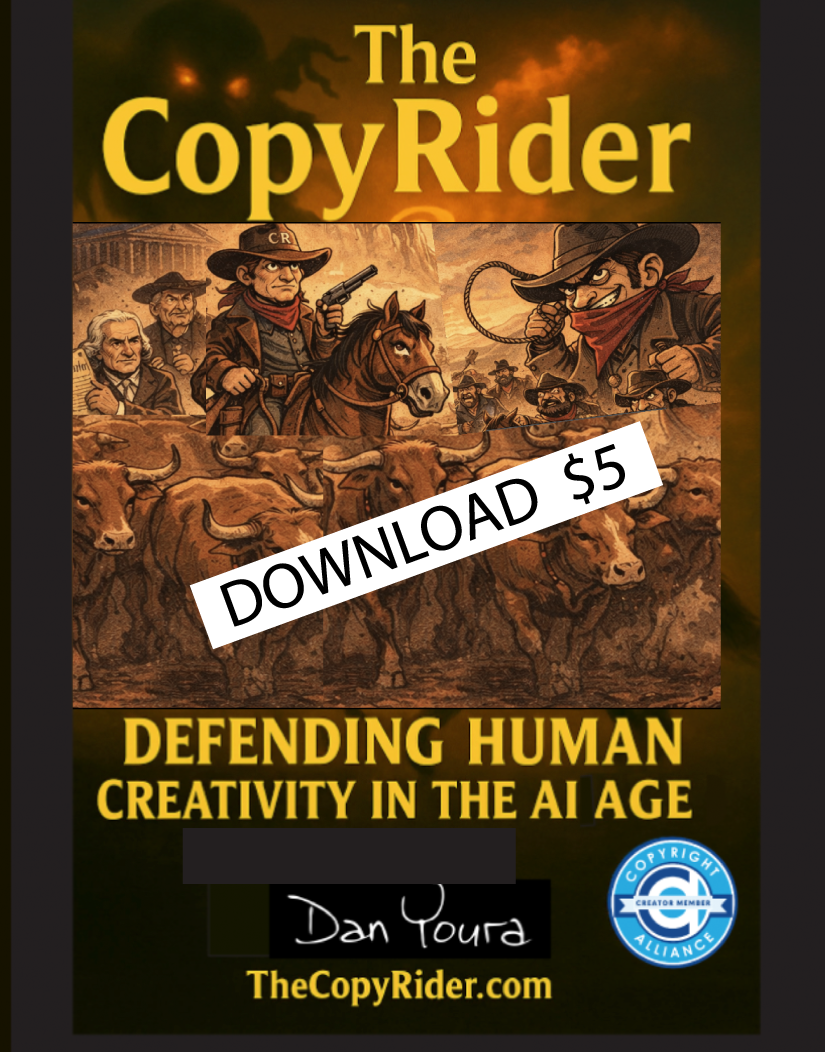
The CopyRider is the allegory — the Wild West town and the open range.
The prairie represents the marketplace.
The cattle represent creative assets.
The cowhands represent creators.
The cattlemen represent investors and organizers.
The rustlers represent exploitation and misappropriation.
At the center stands the mission:
To keep the creative engine functioning so that the broader economic machine continues to run.
This leg integrates:
- The Book
- The Manifesto
- The Code (© = AI + U)
- The Map (operational roadmap)
Without this leg, you have parts without philosophy.
You have tools without direction.
You have actors without a script.
This leg unifies the pieces into a coherent system and explains how AI and human creators can work together without dissolving ownership.
It is still a story — but a powerful organizing story.
It gives meaning to the factory.
Pillar 3. Pill
(Copyright Properties — The Production Studio / Factory)
This is the tangible leg.
It answers the question:
Where is the value?
Here we move from metaphor to manufacturing.
This is the workshop.
The studio.
The factory floor.
Like a small Santa’s workshop — or scaled toward a Universal Studios model — this leg organizes actual, human-created copyrighted characters and creative assets into:
- Cartoons
- Caricatures
- Avatars
- Film properties
- Educational tools
- Spokescharacters
- Interactive models
- Licensing vehicles
- “Action figures” of economic participation
These are not abstractions.
They are fixed, human-created works.
They are:
- Ownable
- Transferable
- Licensable
- Investable
They are the troops.
The teams.
The marching units.
Each one capable of forming alliances with AI tools to expand production — while maintaining human authorship at the legal core.
This is where © = AI + U becomes operational.
The human creator anchors authorship.
AI becomes amplifier, not originator.
The result is compliant, defensible, monetizable creative output.
Without this leg, the enterprise remains theory.
With it, the enterprise becomes economic reality.
How the Three Legs Work Together
A factory without philosophy becomes mechanical and short-sighted.
A philosophy without property becomes academic and powerless.
Property without knowledge becomes vulnerable and exploitable.
But when aligned:
- Knowledge trains the operators.
- Vision directs the mission.
- Property generates the revenue.
The stool becomes stable.
And what sits on the stool?
An observable working model of Copyright Economics — a demonstration that:
Human creativity remains the legal and economic engine
AI becomes the accelerant
Ownership remains the anchor
This is not anti-AI.
It is anti-displacement.
It is pro-structure.
It is pro-ownership.
It is pro-economic continuity.
The Early Launch Principle
In any successful enterprise launch, three generics must exist:
- Education (how it works)
- Integration (why it matters)
- Production (what is being sold)
Most ventures start with only one.
Copyright Economics begins with all three aligned from day one.